
She’d been on thyroid medication for three years. Her TSH was in range. Her doctor said she was doing fine.
She was not doing fine.
The fatigue hadn’t lifted. Her weight hadn’t budged. Her hair was still coming out in the shower. She was cold all the time. She felt, in her words, like someone had turned the volume down on everything.
The medication was managing her lab value. It wasn’t managing her thyroid.
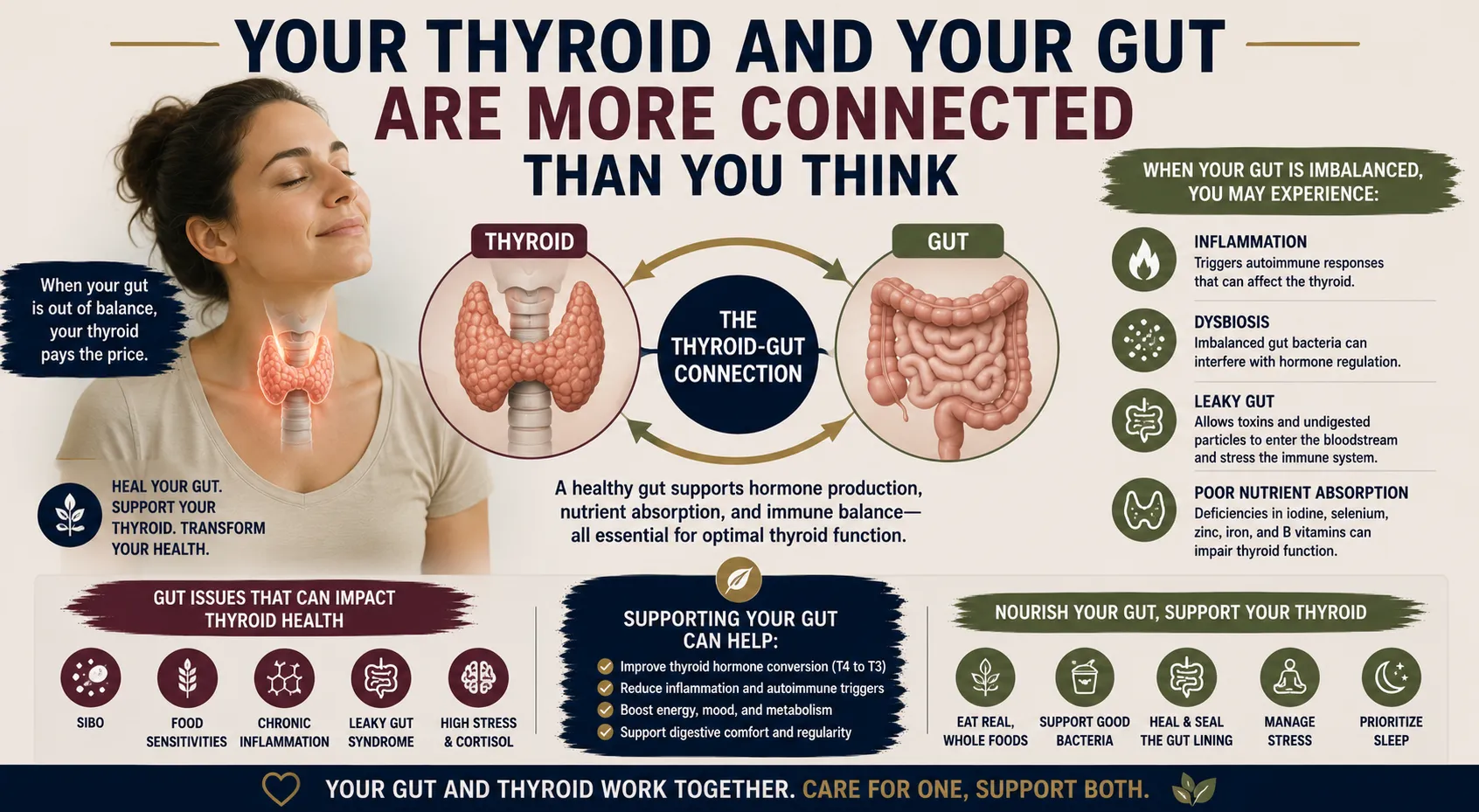
Understanding why requires knowing something most patients are never told: your thyroid doesn’t work in isolation. What happens in your gut has a direct, measurable impact on how well your thyroid functions.
What the Thyroid Actually Does
The thyroid is a small gland in the middle of the neck. It produces two hormones: T4 (thyroxine) and T3 (triiodothyronine).
T4 is the storage form. It’s relatively inactive. Most of the thyroid hormone circulating in your blood is T4.
T3 is the metabolically active form. It’s the one that actually enters your cells and tells them how fast to run. T3 directly influences mitochondrial activity, ATP production, oxygen consumption, fat metabolism, heart rate, digestion, brain function, and temperature regulation.
Here’s the part that gets left out: T4 must be converted to T3 to do anything useful. That conversion happens primarily in the liver. It also happens in the muscles, the brain, and the gut.
If something interferes with that conversion, you can have plenty of T4 circulating and still not have enough active T3 to feel functional. Your TSH might be normal. Your T4 might be normal. And you might still feel terrible.
The Gut’s Role in Thyroid Conversion
Research shows that approximately 20% of the T4-to-T3 conversion in the body is influenced by gut bacteria.
Twenty percent. That’s not a footnote. That’s a substantial portion of how your thyroid hormone gets activated, and it’s happening in your gut through enzymes produced by your microbiome.
If your gut microbiome is disrupted, your conversion is disrupted. You’re producing thyroid hormone but not using it efficiently.
Colin Renaud, DC, PA-C describes why this matters so directly: “Probably almost everybody has a gut problem. Almost every patient I see has some sort of gut problem. So when you’re trying to go to your doctor and have your thyroid regulated, if they’ve got a gut problem and they’re not absorbing nutrients, you’re not going to get very far.”
This creates a cycle that’s hard to break from inside the conventional system. The patient gets more medication. The TSH goes lower. The doctor considers them treated. The patient still feels awful, because the gut that was disrupting conversion was never addressed.
The Nutrient Pipeline
Thyroid function also depends on a specific set of nutrients. Your gut has to absorb them. If gut inflammation is impairing absorption, even a good diet won’t deliver what the thyroid needs.
The key nutrients:
Iodine. Required to synthesize T4. Without enough iodine, the raw material for thyroid hormone isn’t there.
Selenium. Critical for T4-to-T3 conversion. Selenium activates the enzymes that perform this conversion. Low selenium means slower, less efficient conversion even when T4 is adequate.
Zinc. Needed for thyroid hormone production and for receptor function. Your cells have to receive the hormone signal, and zinc is part of that receptor system.
Iron. Plays a specific role in autoimmune regulation of the thyroid. This becomes particularly important in Hashimoto’s, the autoimmune form of hypothyroidism.
Tyrosine. An amino acid used to build thyroid hormones. This comes from protein. People who aren’t eating enough protein, a common pattern in patients trying to lose weight by restricting calories, may be undermining their thyroid at the building block level.
Vitamin D. Deficiency is common and directly impacts thyroid function. It’s also linked to autoimmune susceptibility.
If the gut lining is inflamed, permeability is compromised, or the microbiome is dysregulated, none of these nutrients reach the thyroid in adequate amounts. The thyroid can’t work with what it doesn’t have.
Gluten and the Autoimmune Connection
Roughly 90% of hypothyroidism in the United States is autoimmune in origin. Hashimoto’s thyroiditis is not just a thyroid problem. It’s an immune system problem that happens to target the thyroid.
In Hashimoto’s, the immune system produces antibodies (thyroid peroxidase antibodies and thyroglobulin antibodies) that infiltrate thyroid tissue and destroy it gradually over time. This damage can begin years before thyroid hormone levels drop enough to trigger a diagnosis.
Gluten is one of the most well-documented dietary drivers of Hashimoto’s. The research on this is substantial.
A patient who had been managing Hashimoto’s for years, cycling through endocrinologists who repeatedly adjusted her medication without improving how she felt, finally agreed, after repeated encouragement, to go gluten-free for two weeks. When her antibody levels came back, they had nearly halved. She hadn’t changed anything else. No new supplements. No new medication.
She described feeling better overall within the first week. The antibodies that had been destroying her thyroid tissue were substantially reduced by removing one dietary trigger.
Not everyone with Hashimoto’s has gluten as their primary trigger. But the gut-thyroid immune connection is real, it’s measurable, and it’s routinely ignored in conventional thyroid management.
What the Standard Model Gets Wrong
The conventional approach to hypothyroidism follows a specific, narrow path:
-
Test TSH.
-
If TSH is elevated, prescribe levothyroxine (T4 only).
-
Monitor TSH at 3-month intervals.
-
Adjust the dose until TSH is in range.
-
Consider the patient treated.
No full thyroid panel. No antibody testing. No investigation of gut health. No nutrient assessment. No dietary modification. No investigation of why the thyroid is failing.
The patient who still feels terrible after levothyroxine is told: your numbers look good. I can’t help you further. This is the treatment.
Colin Renaud, DC, PA-C has encountered patients who were told explicitly: “It doesn’t matter how you feel. It’s what your values say.” That is a direct quote from a patient’s previous physician.
The values say the medication is working. The patient says they feel worse than before their diagnosis. The system has no mechanism for resolving that conflict, because the treatment protocol doesn’t change based on patient experience.
What a Full Thyroid Workup Looks Like
A complete functional medicine thyroid evaluation includes:
TSH (the signaling hormone), free T4 (the storage form that the thyroid is producing), free T3 (the active form that’s actually working at the cellular level), reverse T3 (an inactive form that the body produces under stress, which can compete with and block T3 from working), thyroid peroxidase antibodies, and thyroglobulin antibodies.
Each marker tells a different part of the story. TSH alone is like reading the first page of a book and summarizing the plot.
Add to that: a gut health evaluation, nutrient levels, and an assessment of dietary triggers. This is a complete thyroid workup. It’s not exotic. It requires a longer appointment and a broader testing order, but none of the tests are unusual.
Many patients who have been told their thyroid is “fine” have never had most of these markers measured. They’ve only ever had TSH.
The Practical Takeaway
If you have hypothyroid symptoms but your TSH is normal, something else is happening. Possibly a conversion problem. Possibly nutrient deficiencies. Possibly Hashimoto’s with antibodies no one has ever measured.
If you’re on thyroid medication but still feel terrible, the medication is managing one number. It may not be addressing the underlying reasons the thyroid is underperforming.
Your gut is a significant part of this picture. What you eat, what your microbiome looks like, how well your intestinal lining absorbs nutrients, and whether dietary triggers are driving autoimmune activity: all of these connect directly to how well your thyroid works.
The person who goes gluten-free and cuts her antibodies in half isn’t following a trend. She’s addressing a documented physiological mechanism that her endocrinologists never investigated.
The connection is real. The tools to investigate it exist. The question is whether anyone is looking.
About the Author: This article was written by the clinical education team at Med Matrix, a functional medicine clinic in South Portland, Maine. Med Matrix serves over 3,000 patients with a provider team that specializes in root-cause testing, hormone optimization, and personalized treatment plans.